Introduction: Extranational Identification 2
Mathematicians of the empire 3
(Add some imagery from Sideways comic here)\ 4
Group rather than individual 14
Legality, morality, and ethics 15
The Extranational Identification app: User flows 16
Issuer: Defining credentials and issuance requirements 17
Issuer: Issuing certificates 18
Registry: creating and publishing registries 20
Validators: accepting and validating certificates 20
What is a network of networks and how do you know you belong to one?
Extranational Identification allows people to prove their belonging to a particular group, and it allows groups to freely associate with one another.
This specification is the result of more than 100 interviews and discussions with people coordinating or participating in “networks of networks”, coalitions, “ecosystems”, consortia, and other types of groups of groups. The main finding was that there is no tooling for networks to identify member organizations and members of member organizations[b][c][d].
This proposal starts from the point of addressing the need for a commonly used “Extranational” digital identification to span across different types of emergent communities addressing the polycrisis. Furthermore, the solution is designed to be flexible enough to enable people who cannot attain national documents to have a reliable and unique identification document that can prove their eligibility for services provided by different NGOs and communities, as well as their rights to participate in governance or economic institutions relevant based on their eligibility.
In this document, we use the word “identification” rather than identity[e][f]. Identity can be many things. The software [g][h]described in this documentation is a form of identification or authentication that allows a person to prove they are who they say they are, and show something about the context in which they are making a request for access to services. While Sideways is mainly concerned with the human interactions and physical world resources, the solution is a digital solution and therefore can be used across both online and physical world contexts.
This document is the result of research with leaders of groups of groups: consortia, networks-of-networks, umbrella organizations, etc. The Sideways team formally interviewed approximately 50 different organizers who had different approaches to networks-of-networks to assess their needs. We also conducted dozens of informal discussions and interviews on the topic. It also incorporates research with the Self-Sovereign Identity community who have been working on these problems for decades, and who are well versed in the tradeoffs of different technologies as they may be applied to this problem space.
Societal challenge: How can a global movement or alternative society know who is a member of the movement? Increased momentum around addressing the polycrisis makes it impossible to “keep up” with everything that is happening. As we create an alternative to the default way of living, resourcing the movement is, in great part, dependent on being able to identify one another in different contexts[j].
Human challenge: A billion people today are unable to prove their identities for a variety of reasons (collapse of their government, non-person status in the eyes of the regime, etc.). Others may wish to opt out, for example, those joining “Network States”, either formally or informally. Article 6 of the Declaration of Human Rights states “Everyone has the right to recognition everywhere as a person before the law.” That right is completely independent of belonging to a nation. For a variety of reasons, people may wish to declare themselves a legal person, independent of a particular nationhood, and people have the right to do so. Yet, to date, no universal digital solution[k] is available. (Different attempts in the Web3 space tend not to be interoperable[l][m], similar to other existing types of organizational memberships. Similarly, the UN has used digital identifiers for refugees, but these identities are typically used for exclusion rather than inclusion, such as right-to-movement across borders.)
Organizational Challenge: How can an organization maintain cultural norms and ensure that members continue to represent those cultural norms consistently[n][o]? The approach taken in this paper sees the organization as the basic unit of human functioning, and allows each organization to maintain its own standards. An organization is any group of 3 or more people operating under a recognizable name. A network or ecosystem is a collaboration among multiple groups.
The use cases described in this document are already happening. From Indigenous tribes to the Climate Majority to Silicon Valley billionaires, individuals and groups are declaring their dissociation from the institutions of nation-state and corporate capture. They are declaring independence in different ways, and fragmenting into different types of sub-cultures and bubbles of society.
The Mathematicians in Isaac Asimov’s Foundation series cannot prevent the coming turmoil as the Galactic Empire is crumbling, but they can reduce the period of turmoil and chaos from 30,000 years to 1,000 years if they can tap into the collective knowledge of humanity.
Digital infrastructure, such as that described in this document, is our approach to trying to minimize the era of turmoil by connecting the projects that are driving towards addressing the polycrisis and developing new forms of collective societies.
Many people have chosen alternative lifestyles through communities such as Ecovillages, Cooperatives, Network States, Sharing Economies, Community Currencies, Cryptocurrencies, DAOs, Anarchist Collectives, Free Trade Zones, Micronations, and other formations. However, today, those communities connect with one another through the existing systems. They use their mobile phone apps and maps, financial rails, and official borders to connect. If their nation imposes a sanction against another nation, they are blocked from connecting with their aligned communities in significant ways.
Sideways are the ways that we are developing to allow values-aligned communities[p][q] to recognize one another and create a parallel system. The first piece is the simple ability to identify someone as officially belonging to one of those communities, in a way that all of the communities agree upon. On top of this basic identification system, it is possible to build new values systems that are not beholden to the current institutions. It will take time, perhaps a few generations.
Digital identity crept up on us. Digital identity wasn’t even a thing 30 years ago. Now, we can redesign digital identification, taking into account the lessons learned. Fortunately, most of the necessary technology is already available, much as Open Source free software. The main requirement is for people to free their minds and recognize that their identity [r]is theirs alone.
No government can assign you personhood. No protocol can assign you personhood. Your humanity and personhood exist independent of these entities. You are free to declare your associations. At first, as these systems are nascent, most people will have parallel identities in the default system as well as identities in these new systems. Over time, at different paces, different people and communities will choose to live more of their lives in alternative systems. We are attempting to make that possible through fundamental infrastructure that most of us take for granted. Without such infrastructure, we remain fragmented liferafts. With such infrastructure we can create flotillas and eventually islands of coherence.[s]
Extranational Identification allows people to prove their belonging to a particular group, and it allows groups to freely associate with one another.
All use cases are group-based use cases. The logic for using a group as the basic unit of operation is described in the Background section (here).
Identification is a two-sided market. There are those who issue credentials and those who accept credentials. Government authorities issue driver’s licenses. Rental car companies and police officers accept driver’s licenses. The use cases, and this document in general uses the terminology Issuer and Validator because it is common in the digital identity community as a whole.
Groups issue identification in the form of “Good Standing” certificates for members. Good standing means different things to different groups, and that’s fine. Each group publishes the standards for members to maintain the Good Standing certificates. If they do not honor their own standards for certificate issuance, the certificate will lose value (e.g. a Harvard degree isn’t what it used to be). Individuals may hold multiple certificates if they are in good standing with multiple groups.
The Nuncastian are an oppressed minority in their homeland. Both in their homeland and abroad, they are denied legal identity documents. The Nuncastians have a traditional structure of community elders, as well as their own language, culture, and spiritual practice. The elders want to issue Nuncastian identities to their members abroad who have left to escape oppression or for better futures. If a Nuncastian adopts certain foreign habits or harms another person, the elders may revoke their membership, in accordance with Nuncastian traditions.
Nuncastians abroad help one another with integration to new places. They would like to collaborate with refugee communities with compatible cultural practices, but they can only identify their own members, not those of other cultures.
Ecology Extreme organizes people to take civil disobedience actions that have direct impact on the environment. Actions range from causing logging equipment to accidentally fall into the river to saving heritage seeds and planting farms with non-GMO seeds in regions where national governments have ceded power to multinational corporations.
The organization wants to be able to issue a membership credential, first of all, to protect those members who are in trouble with their own governments for such actions[t][u]. In some cases, members are indigenous people who might not have the right to identity from the government, or who don’t want to accept the government’s sovereignty over their personhood. In other cases, the activists are under persecution for environmental action and wish to be able to move around and access services provided by like-minded organizations and people. Secondly, Ecological Extreme wants to ensure that people are not acting in ways that are too extreme, for example, where people might be harmed, or if they were offered shelter by a sister organization and were not considerate of the hosts. Thirdly, EE wants to cooperate with other organizations who sometimes need participants who are willing to take higher risks than those partner organizations can take. The partners need to be able to identify members who are “safe” to talk to about risky actions.[v][w]
Scitopiana is a Network State committed to the betterment of humans through technological augmentation. Many Scitopianians no longer wish to be associated with their nation of origin, either because of the tax affordances of Scitopiana, or because of ethical considerations. While they use passports from nation-states for travel, they would like an independent identification they can use among different Network States. Scitopiana has relations with other Network States and also recognizes Nuncastians and other populations that might not be recognized by the default nation-state system. Scitopiana believes any human has the right to self-identify and they are entering into different types of commercial and political travel arrangements with other Network States. Having a digital identification document for their citizens allows them to operate businesses, maintain self-sovereign control of their medical records, and participate in the country’s crypto-based financial services sector.
The Hippeati Commune is a regenerative village of 80 families living in harmony with nature. Hippeati is part of a network of intentional communities that provide different ways of living to their members. Members can move among villages when their life circumstances change, for travel and vacations, or for knowledge exchange. The intentional community network uses identification authentication for different levels of access depending on the relationships among different intentional communities. Hippeati also may offer space to Ecology Extremists or Nuncastians, regardless of their legal status. They maintain commercial agreements with Scitopia but do not allow Scitopians (or other genetically altered creatures) on their territory.
Verifiers provide services. Each Verifier determines what certificates they will accept and under what terms they will interact with those who hold certificates. Individuals have the ability to show or hide whatever certificates they chose. The initial system specification shows direct relationships between Issuers and Verifiers, but as the system grows, intermediaries (Registries) will be needed for different levels of assessment of credentials.
Health4All is a non-profit organization operating health clinics for underserved people, regardless of their affiliations and nationalities. They use a portable digital health record system to allow patients to carry their Electronic Health Record (EMR) with them as they travel. Health4All provides services to digital nomads, refugees, and other uninsured people, based on a sliding pay scale. They recognized the identifications from all of the organizations above. For Nuncastians, they provide free or minimally priced services. For Ecology Extreme members, they provide services for those who are in danger of being accosted by legal authorities if they self-identify at government health agencies. Most Hippiopiansa are covered by their national health services, but they often come to offer emotional or alternative healing services at Health4All. For Scientopians, Health4All offers international health insurance programs, ZK-EMR services, and a variety of confidential services for recovering Biohackers who have tried too many experimental procedures.
Baskata is a collective of people with nationality in a Spanish-speaking country, but whose culture dates back prior to national rule. Baskatans have a number of locations in their indigenous territories where they are restoring historic villages. Baskatans have space to accept digital nomads, refugees, and other “unwanted” peoples into their communities, as long as they have good standing in their own communities and are willing to work on the restoration of these villages and learn the language of the locality.
Ecolrner is a loosely associated group of alternative education and “homeschooling” locations, organized by parents who prefer not to send their children to nation-sponsored schools, or who are unable to because they are not recognized by the nation in which they live. Ecolrnr is resourced as a commons. For example, teachers may live in an intentional community and have their needs taken care of, rather than being paid in monetary terms, or the teachers may just be homeschooling parents who share teaching days among themselves rather than hire teachers. Different Ecolrnr locations have different policies about who to accept to the collective based on their identification, needs and abilities. Some Ecolrnr locations are recognized by the national authorities, and others prefer to go under the radar.
ChickenBus is a collective of drivers with their own vehicles, providing transportation services that may or may not comply with national and international standards. ChickenBus provides a variety of other types of local and trans-national transport services to those who belong to different groups in the network. They provide free school bus services to Nuncastians children going to Ecolrn. ChickenBus requires documents of good standing for transportation of refugees and other unwanteds, to protect their collective from being reported to the authorities.
ChickenBus has an elite transport service (ChickenBus Scientific) which may or may not be involved in transporting certain types of minerals, chemicals, and biohacking essentials to Scitopiana, as well as “natural pharmaceuticals” to Hippeati. They also are able to transport low-cost pharmaceuticals from India and China to Health4All worldwide locations.
Medium to large-scale credentialing systems require intermediaries, typically in the form of registries. A registry is a list of trusted credentialing authorities. For the initial iteration of this system, we imagine direct issuer-to-validator relations, but the architecture will provide for the addition of registries or other types of intermediaries.
Real life examples of intermediaries and registries:
Another approach to intermediaries is using machine-generated algorithms to provide a reputation score. The Ethereum Attestation Service founders have suggested that this approach will be used for the credentials issued on their service. That approach is less common and is more typical in closed systems.
Real life examples of reputation scores:
In all of the above cases, the algorithm of the score is somewhat opaque, and it is possible for any of those entities to weigh the scores to benefit themselves. For example, Uber might observe that people give lower ratings if their skin color doesn’t match the skin color of the driver, and they might compensate for that in their algorithm. We aren’t saying that happens, we are just saying we have no way of knowing.
The de-nation coalition encourages people to take back their freedom. The de-nation affiliation is an anonymous group of cyberpunks who help organizations implement software to take back their privacy and autonomy. De-nation provides a service to validate credentials and publishes the following registry lists:
De-nation coalition accepts applications for issuers who want to be on the registries with a sliding scale for applications depending on the number of members and the paying capacity of the organization. They also maintain an online complaint process so that if there are multiple verified complaints against members of a listed organization, they may be removed from the registries. De-nation also has a conflict resolution body, so that those complaints can potentially be resolved for a fee that covers conflict resolution costs.
Earth Huggers Unite (EHU) is a coalition providing a registry of organizations such as Ecology Extreme (above) who issue credentials to members of climate activism, regenerative, and environmental organizations. To get on the EHU list, an organization needs referrals from other organizations. Once an organization is accepted, they need to also volunteer as part of EHU to investigate and approve of other applications to the EHU list. To get on the EHU registry, the membership requirements must involve at least 100 hours per year of activism or contribution to the members organization, adherence to a code of conduct, and integrity in dealings with other organizations.
For those who are unfamiliar with identity technology, this section explains the different components of a technical solution and why they should be separate components. As users of reputation and identity solutions, most people never notice these distinctions.
For a system that is decentralized and useful across different applications, separating the components is important. For example, the most common identification issuer is the government. Have you ever gone through the fast-track security lane or noticed that there are barely any checks of your identification in some countries? It’s seamless because many separate processes are bunched together and controlled by one entity.
The system outlined in this document separates these processes so that the control is in the hands of the actual person who holds the identification information. In this system, no one entity could take away a person’s identification information.
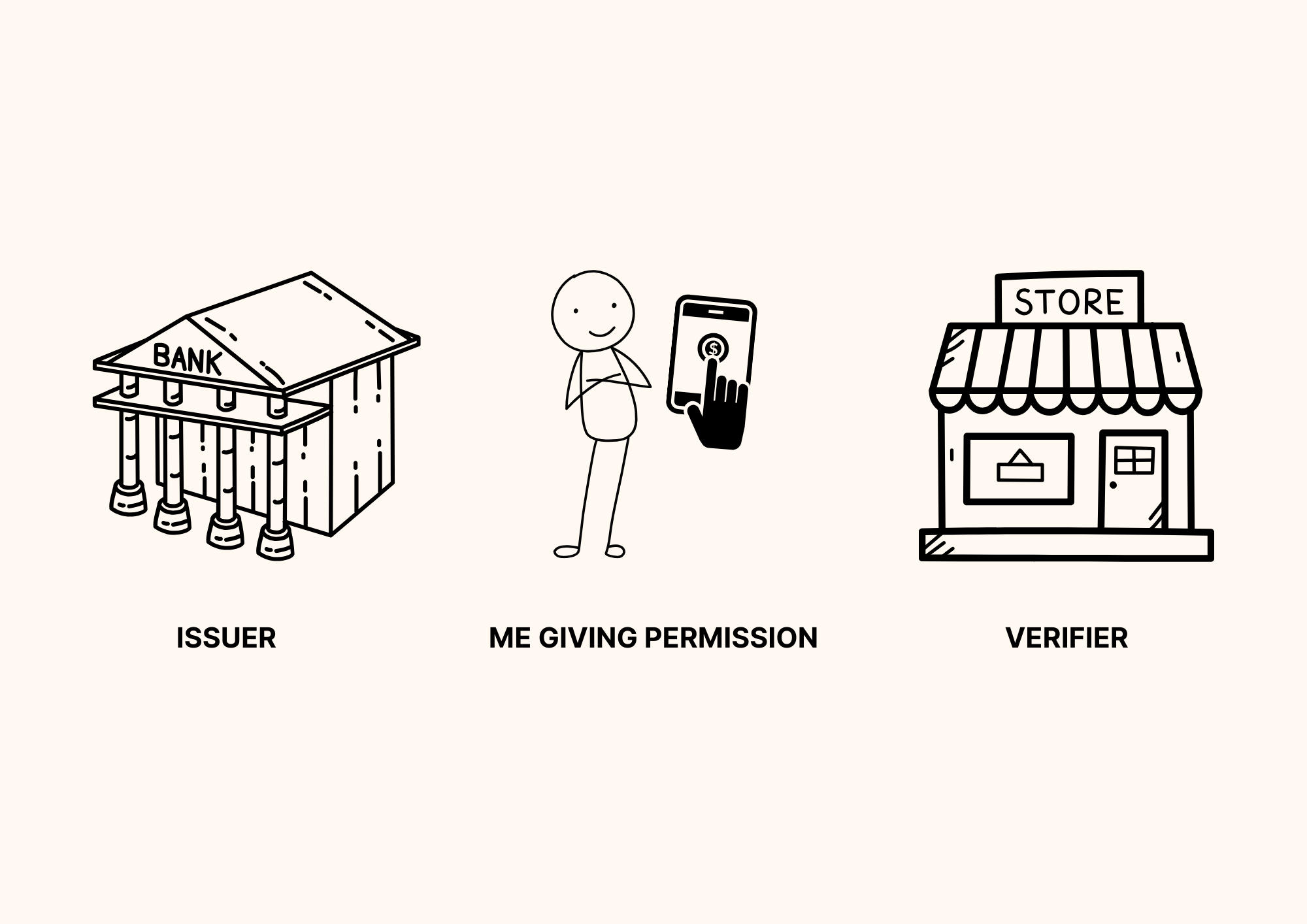
On the first level, it’s easy to imagine this system as an app like the pay application on your mobile phone.
Your app has the details of your bank or credit card. The shop has a point of sale system which knows how to read the credit card, and you approve the purchase. In this system, we would say the bank is the “Issuer” and the shop is a “Verifier”. You are the person in control of the interaction. You could choose a different credit card, for example. Notice also that the Verifier, the shop, can decide that they take cash only. The Verifier has the “access” that you want, and they ultimately can decide what types of money are good at their shop.
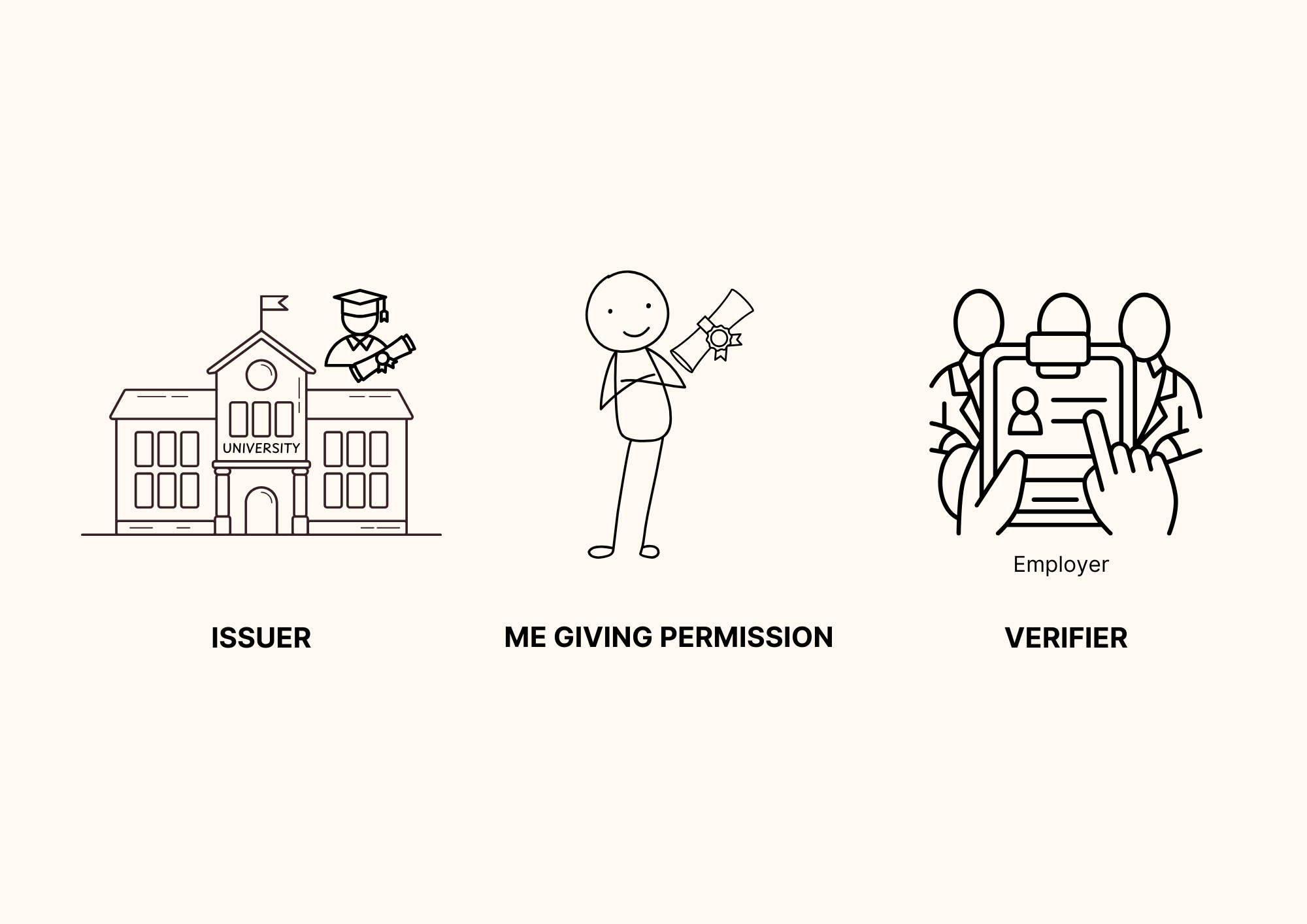
An example closer to the identification system described here is the one below, where you get a university degree.
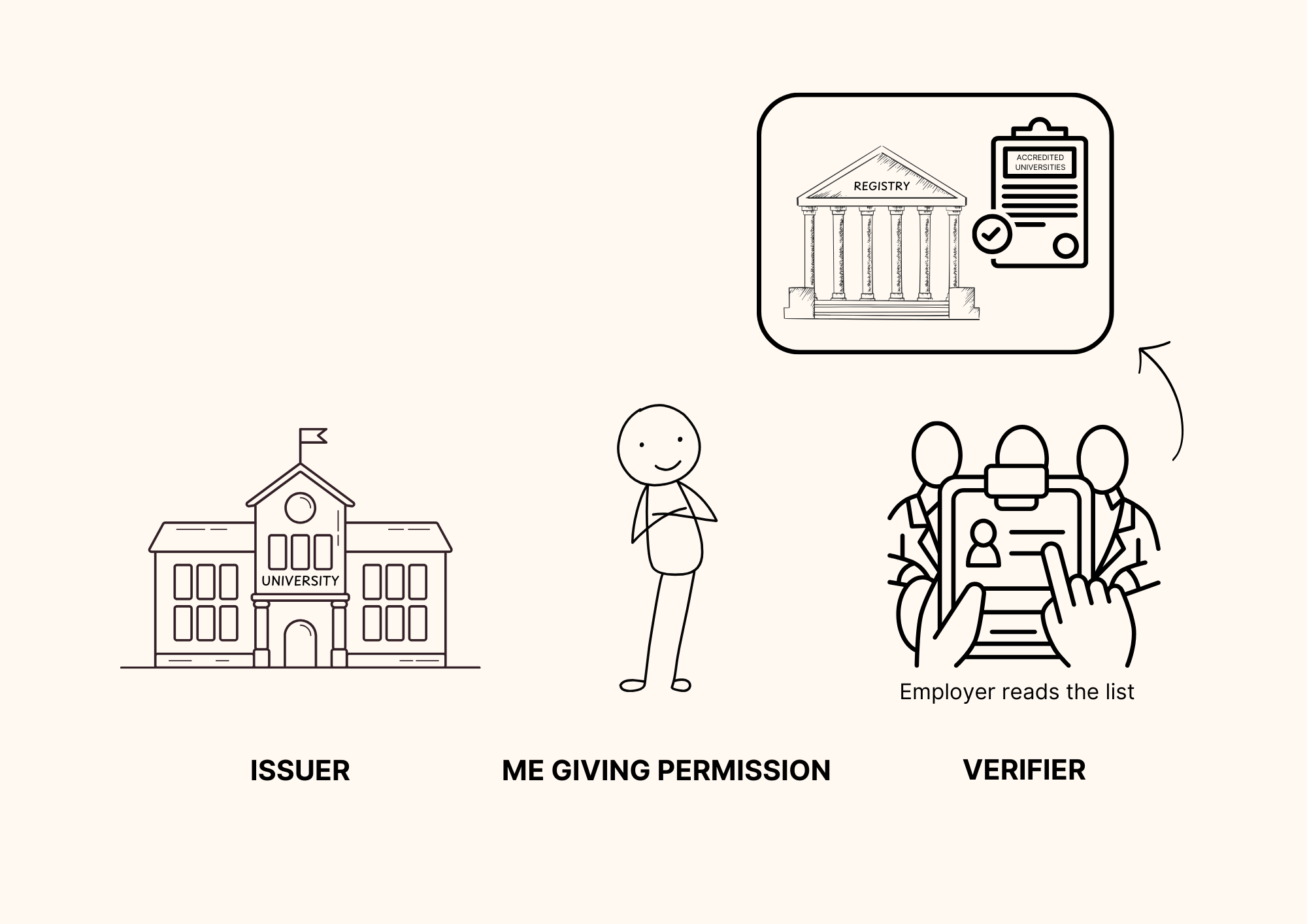
The university issues the degree, let’s say it’s an architecture certification. When you apply for the job, you show the degree. The employer decides whether they trust the certification for that job. Already you can see there are two components the Verifier is considering: the type of degree and the quality of the university. The university (Issuer) needs to maintain its reputation for the degree to be worth having. This is why you can say something like “A Harvard degree doesn’t mean what it used to mean.”
Once you understand this architecture, you can see it anywhere you show any type of credential. When you rent a car, the rental company decides whether your driving license is valid enough. And you are in control of what document you pull out. You might have multiple degrees or more than one driver’s license.
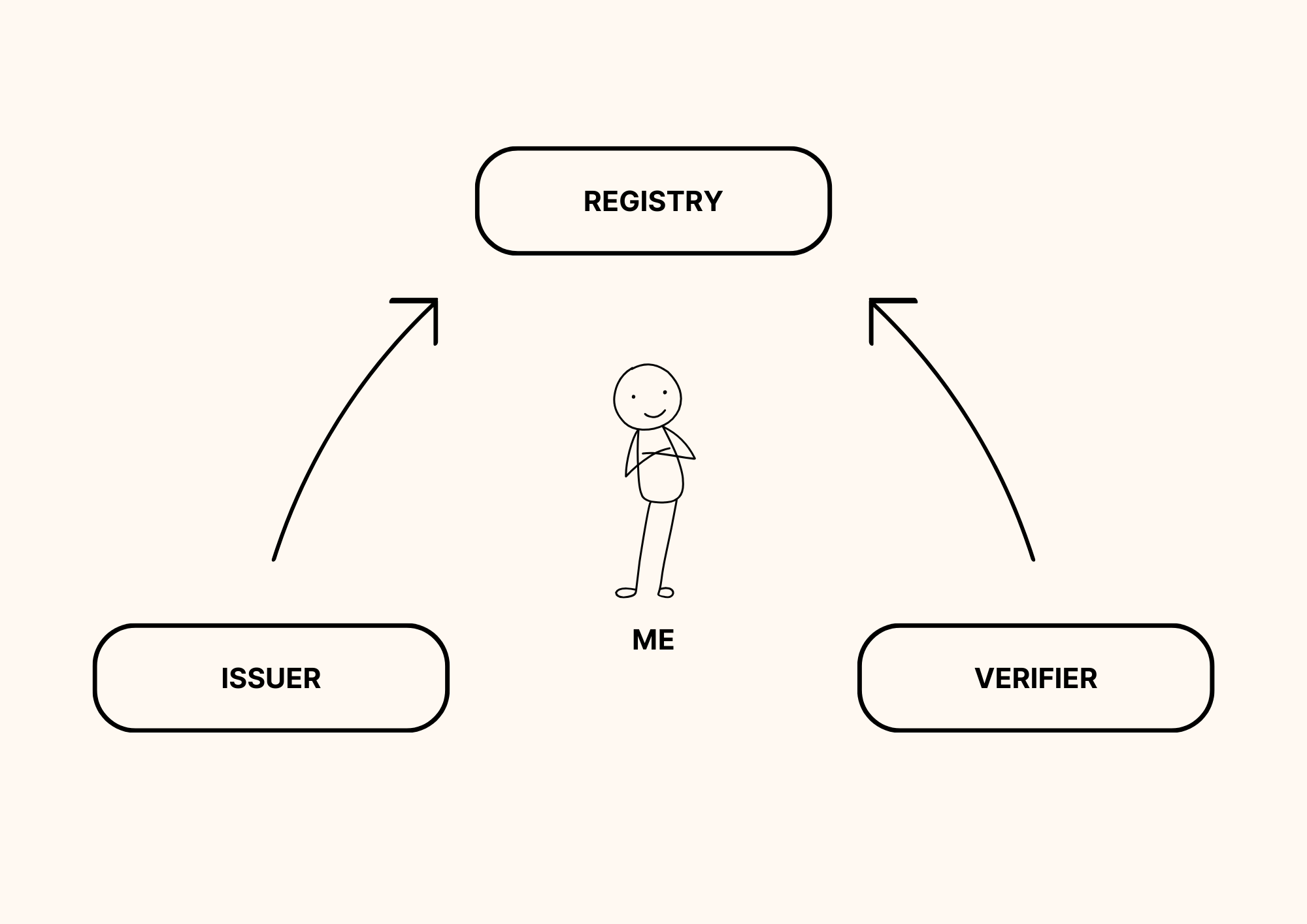
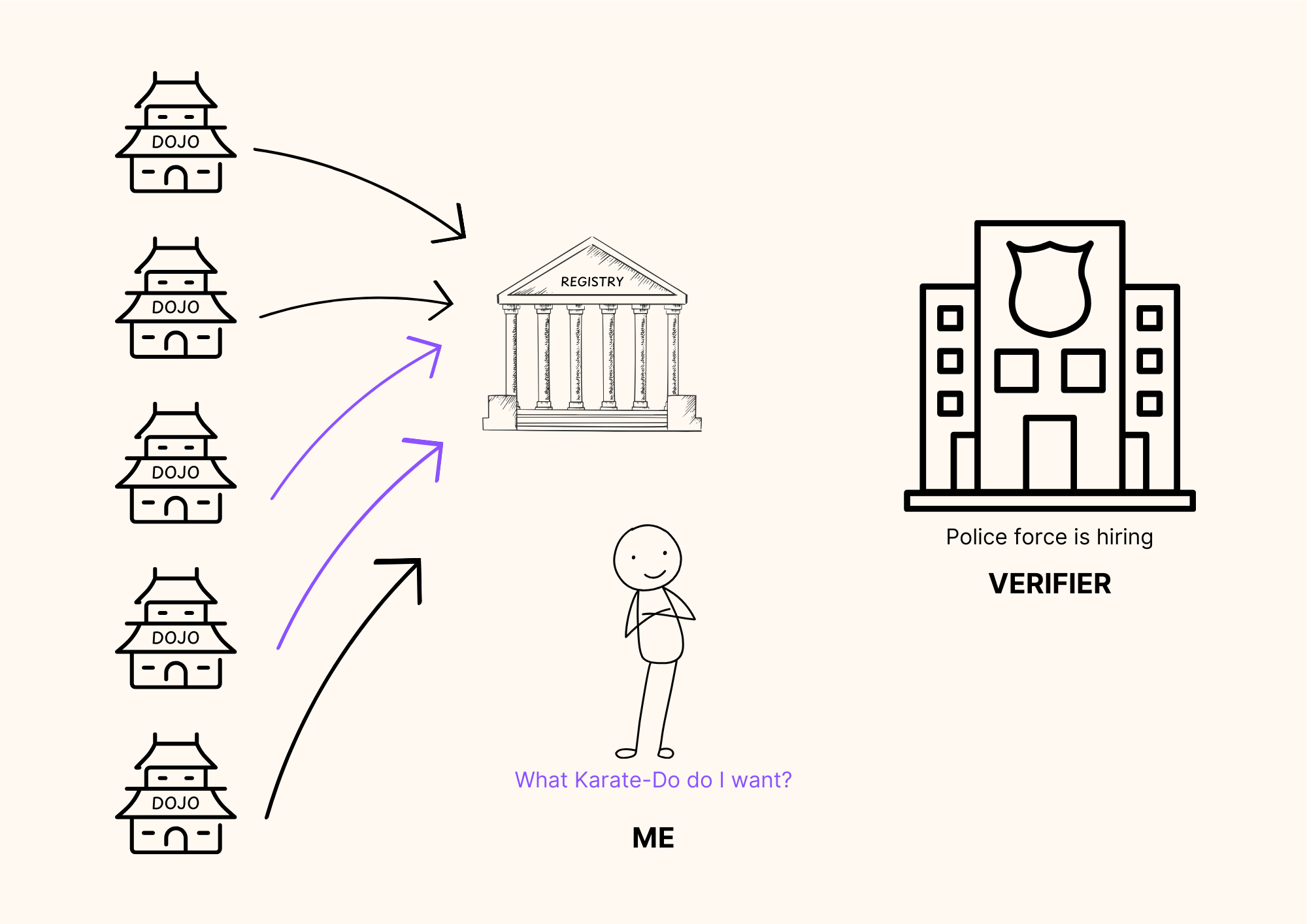
You might notice that there’s another entity in many of these cases, and we call that entity the Registry. For academic institutions, there are entities (usually government ministries) which issue a list of “Accredited” universities. Similarly, governments may determine the authorized list of insurance companies. It’s not always a government, for example, the International Shotokan Karate Federation (ISKF) gives a list of official dojos, so if you get a belt (another type of certification), and it is from one of the dojos on the list, that is a valid belt in that particular discipline.
The image below shows the general architecture for that type of system.
The Verifier might know the Issuer, or they might not. The Verifier has to meet the qualifications to be on the Registry, and the Verifier can look at the registry to find out if the Issuer is a good one. Nobody gets to look at what I have in my hands unless I show it to them.
When it comes to “control” or “decentralization”, it is obvious that there can be any number of issuers. There are plenty of educational institutions that are not accredited (like the dojos). Anyone can create their own class and issue a certificate. Anyone can ask you to show a certificate. What is less obvious today is that the Registry can be decentralized. Except in the karate example, if you look online, you’ll see dozens of different ones, and I’m sure someone knows the difference between Shidokan and Shokotan and Karate-Do, and I’m sure they are very important distinctions even though they mean nothing to me.
This might seem like a trivial example, but you can see how it applies to different certificates in an extranational identification system. Different Network States, DAOs, and NGOs could be Issuers of identification certificates. They could also be Verifiers, and there could be many other Verifiers. Each Network State would have a different Registry they refer to when deciding what other certificates to accept.
Case for group as the basic unit of operation: Our hypothesis is that it is only through “groups of belonging” that humanity can pull through the existing crisis. Vouching on an individual-to-individual basis carries too little risk to the person vouching, and too little enforcement. Groups are able to maintain standards and codes of conduct, guide or rehabilitate those who breach standards, and exclude those who violate the culture of the group. People can freely choose to belong to groups (or not), and anyone can form a group that maintains a culture. A family is a group that maintains a particular culture.
The credentialing system described in this document could potentially be used for more nuanced reputational certifications. Going back to the dojo example, a dojo could issue digital certificates equivalent to “belts”. Someone could hold a green or purple or red belt from their Karate dojo. In the DAO space, different types of reputation scores are being worked with. Hats provides role-based certificates, Gitcoin provides a “passport” score, and others are working on different ways of more nuanced vouching systems.
Despite our sense that reputation is a key primitive that can be used to replace some aspects of the monetary system, our research has convinced us that a simplified “Good Standing” system is the most practical approach to reputation for several reasons:
In some ways, collecting lots of badges and credentials gives rough reputational information, and it might be the best that can be done in an open system.
The Extranational Identification system is being designed with positive evolution in mind. We want it to be used by social change activists, ecological and regenerative communities, and for humane causes. At the same time, some regimes in the world feel threatened by activist movements. As a colleague once commented “one man’s terrorist is another man’s freedom fighter”.
In other words, legal is not the same as ethical or moral. When we are faced with a choice, it is our duty as human beings to make the ethical choice. Fortunately, under international law, we can base our activities on foundational documents such as the Universal Declaration of Human Rights (USDHR) as well as the Universal Declaration of Indigenous Rights and the Rights of Nature (which we expect will be adopted by the UN within the next few years).
The Extranational Identification can be used for any type of membership card, and it provides a quality of interoperable identification that previously could only be provided by governments or large corporations.
We believe that groups of values-aligned people have the right to live according to their values as long as they do no harm to others
We don’t believe we have the right to impose our ethics or morality on others.
Therefore, we are creating technologies in collaboration with social and environmental activists, knowing that any club or community could use this same technology. We are creating technologies that are ethically agnostic, because we do not have a monopoly on ethics.
The examples in our Use Cases section represent a variety of different values, not all of which we share. Yet, we believe that humanity’s survival depends on the great variety of different cultures, religions, and values that form complementary opposites that bring harmony and homeostasis to our habitation on earth. Therefore, we trust in humanity to use these systems in a way that may seem dysfunctional in some areas, but which is overall necessary for the blossoming of different cultures.
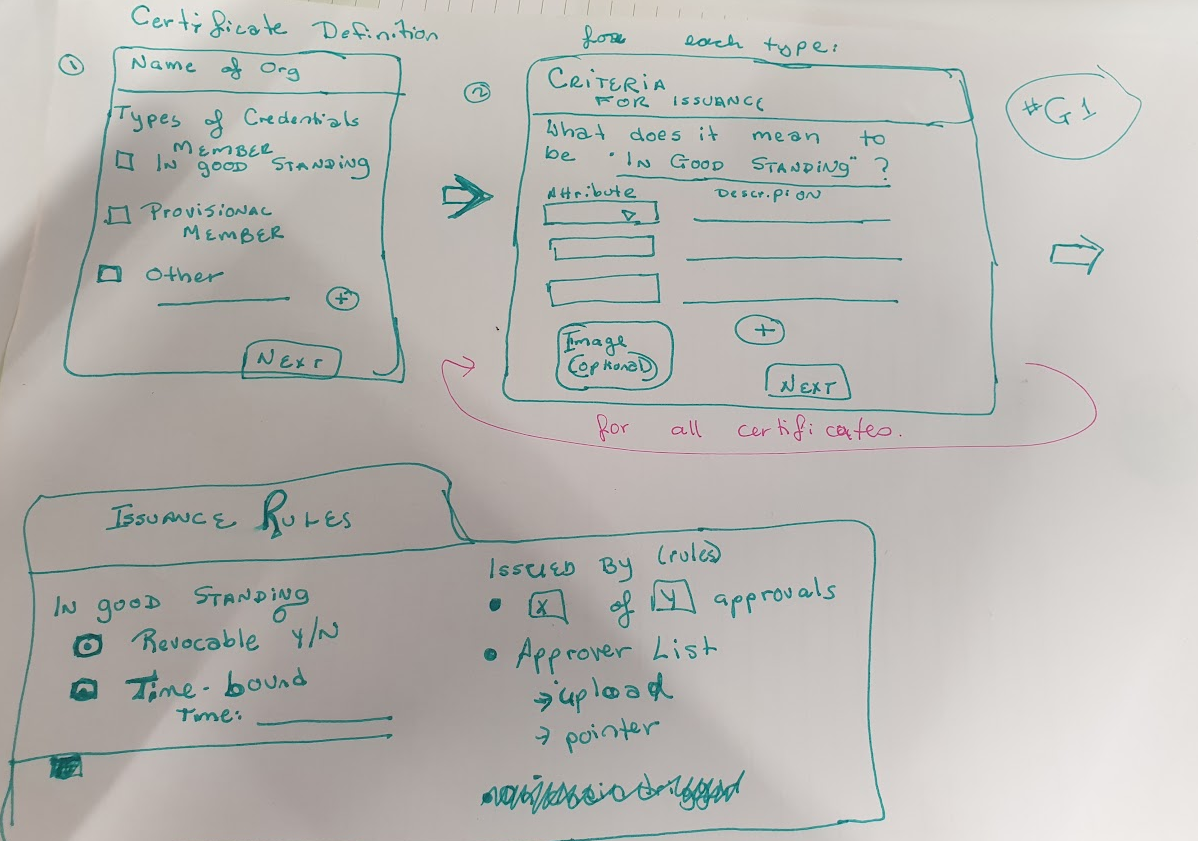
By default, Issuers are offered 2 types of credentials: Membership (In good standing) and Provisionary membership. Credentials can be permanent, time-bound, or revocable. To define a credential, the administrator creates the credential, name, and image, and writes a text-based list of what it means to hold such a credential. They then issue rules on who can issue the credential.
Examples (from Use cases) of the type of issuance and the issuance requirements:
Note: The Extranational Identification protocol is agnostic to how organizations keep their own records. Member organizations might use real or fake names, use Google Docs for their members list, have a secret list or a public blockchain list, or use a piece of paper. It is not the business of the Extranational Identification protocol to dictate how any organization runs itself. The Validators and Registries might care about those things and provide access based on how they perceive another organization, but again, that is not the business of the Extranational Identification protocol. We just provide a communications network upon which aligned organizations can identify members of their partner organizations.
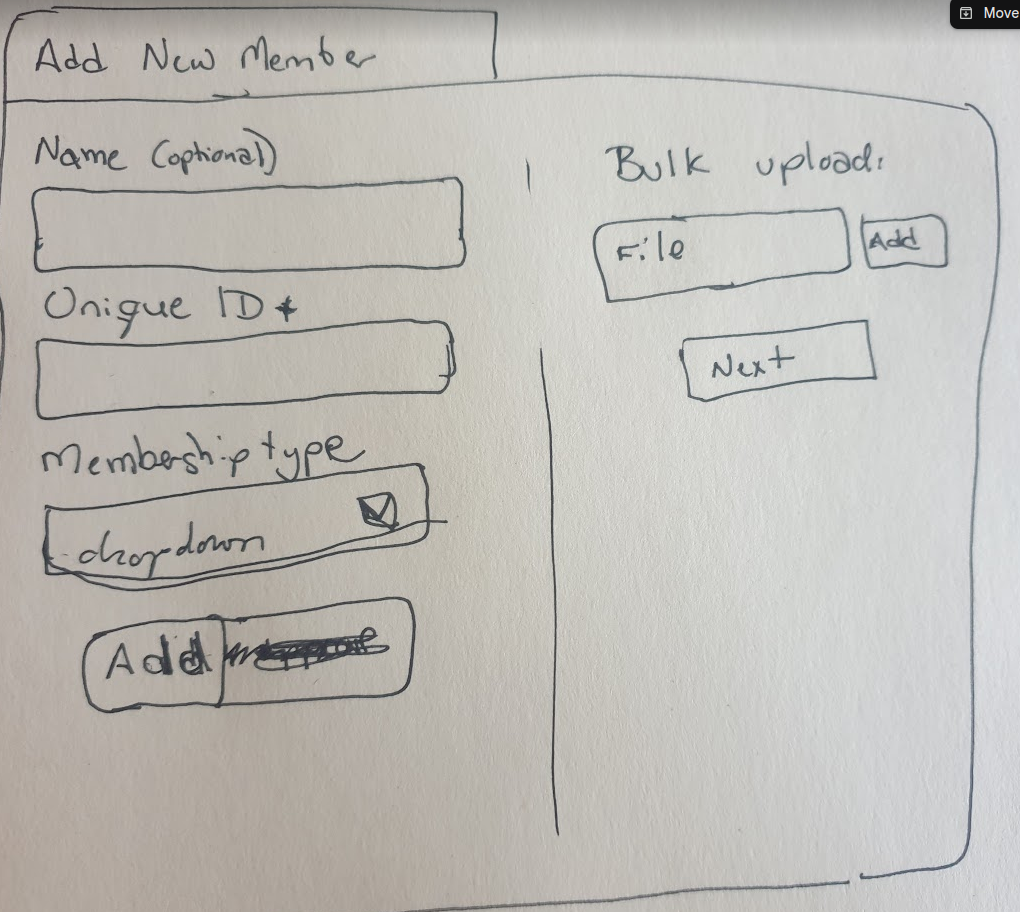
Issuers have defined the rules that are required for approvals. Anyone who is authorized to approve someone for membership can enter the name of the person into the system to initiate the process as well as provide the first approval for the member or members they add. The system will also allow uploading of a list file for bulk approval.
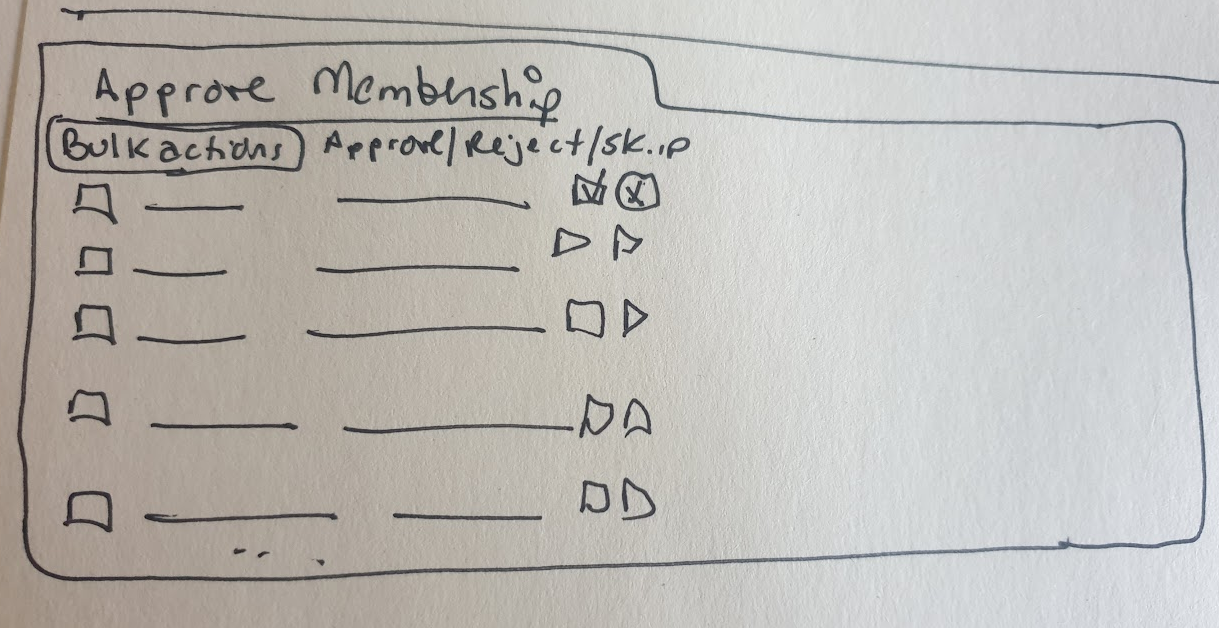
After adding the new member or performing a bulk upload, the person will either approve issuance of the certificate, decline, or abstain. It is possible that someone will have the job of uploading membership requests but not approve all of them. For example, if someone uploads a list of applicants for membership, but they can only vouch for the ones they know, they may not be in a position to give final approval for the certification.
Where more than one approval is needed to issue a certificate, approvers are sent periodic email notifications to approve new members, and they can log on to the app to see their list of members to approve. For example in the example we gave above for Ecology Extreme, three administrators are needed for activists to achieve good standing.
In systems where an objective criteria needs to be met (for example, in a DAO where someone needs to work a certain amount of time or hold an NFT), the app will have an API which allows for automation of the process.
In the first phase of the issuance of the Extranational Identifications, there will be a closed group of groups issuing and recognizing each others’ certificates. At the same time, all of the work will be open source so that others can create interoperable certificates. Once the proof of concept is complete, the system, apps, and standards will be opened up to any group.
During the initial trials, probably up to approximately 100 groups, it will be manageable for groups to maintain their own registries of what certificates they accept on what basis.
Conceptually, we expect the registries to be simple lists, something like json files, that are able to be used by the validators of the certificates in the apps they will use for their own purposes.
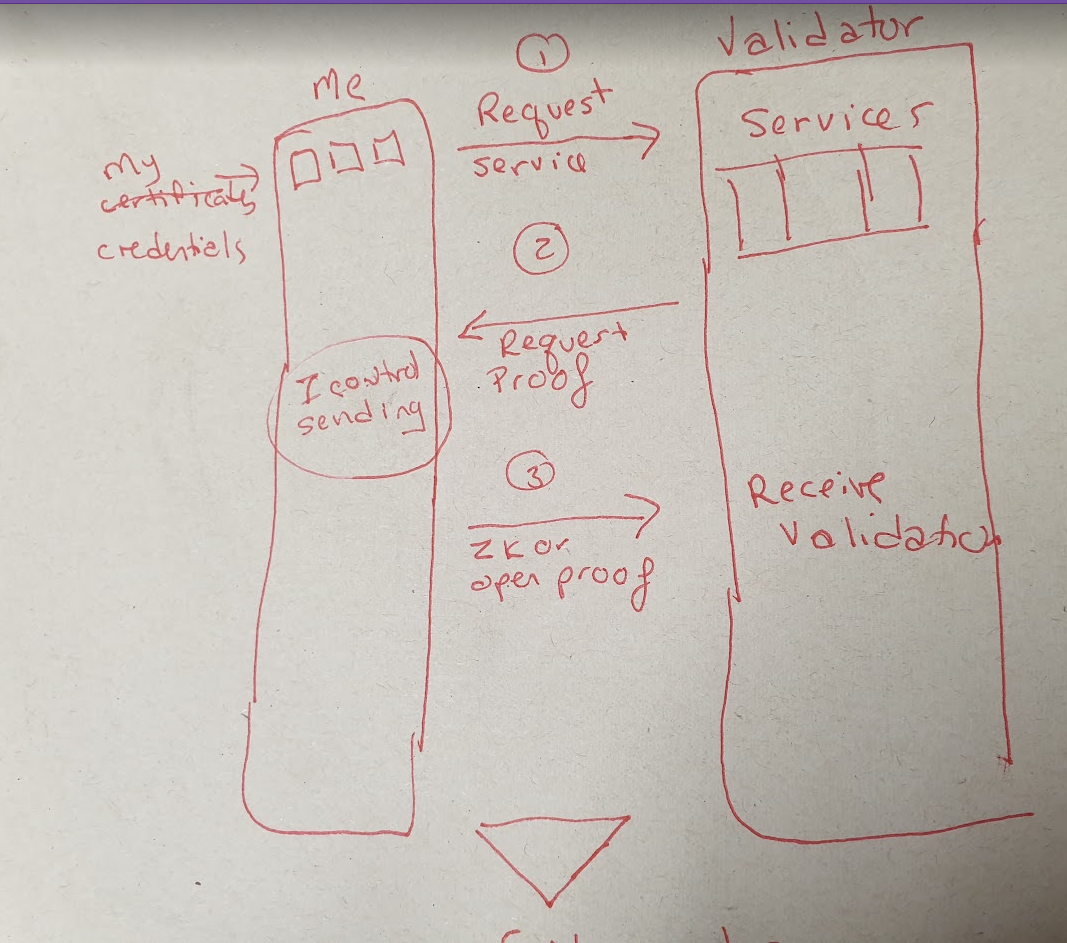
Acceptance and validation of certificates will be possible on a customizable basis. The initial implementation will have a simple interface where an organization can create a list of the certificates they accept, or use a registry of the certificates they accept. When an individual wants to claim a privilege given by a validator, they will validate themselves either digitally with their public key, or in person using a QR or NFC code.
The process will be as follows:
Services could be online services, such as access to gated content, or in-person services, such as entrance to a physical hacker house.
<rant>
It drives us crazy to hear government officials talk about how they “assign” people identities and how there are people who don’t have identities because a government authority didn’t give them an identity. Identity isn’t assigned. It’s just there. If your government disappears tomorrow, you aren’t going to evaporate suddenly. Last names didn’t even exist until a thousand years ago, when English Barons decided it would be easier to collect taxes from people if they could list them all.
It frightens us that there are entities who can “erase” your online identity in different ways. De-platforming and shadow banning are new concepts that convey the inordinate power held by commercial entities to impact people’s social lives and livelihoods. Governments, too, are designing digital identities which give the bureaucracy the technical ability to revoke digital identity capabilities, rendering people unable to receive basic services.
</rant>
The Extranational Identification puts identity where it belongs: in the hands of the individual holding credentials, and at the discretion of the issuer to vouch for any individual that the issuer wants to vouch for. With that in mind, the following design considerations inform the technical specifications:
The basis for self-sovereign identity is the Digital Identifier (DID) and Verifiable Credential (VC) technology defined by the W3C. These have been significantly advanced by the KERI Framework which allows people to issue their DID and use a more advanced credential type called Authentic Chained Data Containers (ACDC). It is beyond the scope of this paper to do a deep dive into this technology. The design principles align with the needs of the Extranational Identification, and it is our intention to implement KERI for this system.
Sideways is a not-for-profit entity providing Civtech for a variety of organizations. The Extranational Identification is a core technology for communities worldwide. Income sources will be:
Sideways Extranational Identification Authentication
[a]What kind of document is this? :)
[b]What are the core problems arising out of this? Further down a solution is mentioned, but I only have a gist of an idea what the problem is.
[c]Also: What alternative approaches are taken and how are they insufficient?
[d]Answered in main document.
[e]Very important distinction! Might be more of a footnote though, as it distracts from the main point.
Összesen 1 reakció
Jack Becher ezzel reagált: 👍 (2024-09-23 08:32 de.)
[f]Created terminology section in main document
[g]I'd rather talk about a "system" of identification, than "software". Reason being that software alone will never solve a true identification problem. It can only be a tool.
Összesen 2 reakció
Jack Becher ezzel reagált: 👍 (2024-09-23 08:32 de.)
Rebecca Rachmany ezzel reagált: 👍 (2024-10-30 09:31 de.)
[h]done
[i]Challenges to what exactly? Challenges to building software for verifiable community or to the (so far unmentioned) problem of why we need verifiable community in the first place?
[j]In order to do what? (I have an idea, but it'd be an important spot to give examples, I think)
[k]... which is required in order to ... ?
[l]so it's about interoperability?
[m]Yes
[n]On the theoretical side there is another issue as well: Norms need to shift over time. So it's not just enough to just keep them, but instead we want generator functions that delicately advance norms.
(E.g. just imagine if systems would be great at keeping norms about slavery, patriarchy, etc.)
Összesen 1 reakció
Jack Becher ezzel reagált: 👍 (2024-09-23 08:35 de.)
[o]Yes.
[p]This seems to be front and center in regards to problem definition for me :)
Why need it, what is the vision for it?
Összesen 1 reakció
Jack Becher ezzel reagált: 🌟 (2024-09-23 08:35 de.)
[q]Yes, this is the core of what we are doing. I think it's a bit too complicated to explain how we arrived at a homogeneity of culture that is outlawing normal human behaviors because they don't fit with the "default" culture. Simple examples: saving seeds, gift economies. Yet, explaining these simple examples takes a long time, so we're going to have to ride on some basic assumptions that we don't have to explain the metacrisis. (If we have to explain this stuff, the person probably isn't a potential user/partner/funder.)
[r]In the section above it was just identification...?
[s]This should go in a vision section, imo.
Összesen 1 reakció
Jack Becher ezzel reagált: 👍 (2024-09-23 08:35 de.)
[t]That sounds like it could well turn out like the UN example, though.
[u]The main differences should be: 1. As an individual, you can decide what credentials to show within the network and 2. Even revoked credentials could be shown as expired or invalid, but they could prove a past membership.
[v]So there's one of the problem statements: How to establish trust in decentralized, disconnected systems?
Solution hypothesis: By certifiable, unforgeable markers that depend on history of interaction with trusted peers.
[w]Solution hypothesis: By certification by an entity which takes the responsibility for misbehavior. In other words, not by past behavior but by future consequences (combined with a history that the vouching entity believes they can trust).
[x]Összesen 1 reakció
Bernhard Frey ezzel reagált: 😂 (2024-09-17 11:39 de.)
[y]Összesen 1 reakció
Bernhard Frey ezzel reagált: ♥️ (2024-09-17 11:39 de.)